Release Date: 9-MAR-2023
GP Versions: 12/14/16/18
MOGenerator Build: 4.116
* Create Child MOs from SOP: fixed issue that caused the routine to execute when unlinking a Sales Document from an MO

Software for Dynamics GP & BC
Release Date: 9-MAR-2023
GP Versions: 12/14/16/18
MOGenerator Build: 4.116
* Create Child MOs from SOP: fixed issue that caused the routine to execute when unlinking a Sales Document from an MO
Customization CR1449
POP Receipt Post SN Performance
Description of Need:
ACME has some serial numbered items in Dynamics GP that are purchased in very large quantities (such as 100,000). During PO Receipt Entry the window verifies that each serial number does not exist in either the Serial Master or on another unposted transaction.
During posting it again verifies that the serial numbers do not exist in the Serial Master (but it does not check other unposted transactions). Because it performs the verification one serial number at a time, the posting process can take more than 40 minutes.
ACME would like to reduce the amount of time it takes to post PO Receipts.
Description of Solution:
The first option we considered, and tested, was to force the POP Receipt Posting process to skip verification of the serial numbers. This could work and would be the fastest approach, however it would create an unlikely, yet possible, scenario where duplicate serial numbers are added to GP.
The proposed approach is to modify the POP Receipt Posting process so that it performs a mass validation of POP Serial Numbers against the Serial Master. This will be a single SQL query that checks for matching serial numbers between the POP Receipt Serials table and the Serial Master. This approach retains the same data validation that Dynamics GP would otherwise perform one serial number at a time.
In the unlikely event that a POP Receipt has a serial number that already exists in the SN master, the POP Receipt will not be posted. An error code will be set on the POP Receipt Header that indicates “One or more line items contains errors.” This error will print on the POP Receivings Posting Journal.

This modification to the posting process will apply to Transaction, Batch and Series posting.
Assumptions/Requirements:
For Information on this customization, or any other WilloWare customization or product, please contact us:
Customization DS1257
List Price Per Site
Problem Definition:
ACME sells landscaping products, such as stones and pavers. They have numerous stores. Due to the difference in the cost of transport to get materials from the manufacturer or quarry to the different stores, each store needs to sell at a different price.
ACME creates Item Price Lists using “Percent of List Price”. Contractors may have different negotiated rates so that, for example, one may get 92% of List Price while another has 93% of List. Since pricing to the customer is based on Percent of List, and the cost to have material delivered to each store is different, in order to maintain a desired profit margin across all sites the “List Price” needs to vary by location (i.e. List Price is higher the further it is from a quarry to account for delivery costs).
Additionally, each store may sell a given product in a different Unit of Measure (such as Yards or Tons).
To accomplish the above requirements, ACME would like:
ACME is not using Multi-currency, so the List Price is set on the Item Maintenance window.
Design Features:
Item-Site Sales Maintenance
Navigation: Cards >> Inventory >> Item-Site Sales Maintenance, or from Item Maintenance >> Additional >> Item-Site Sales Maintenance
This window is used to set up Site specific selling options for Inventory Items. The List Price and Default Selling U of M can be specified per Site. These values are used in Sale Transaction Entry.
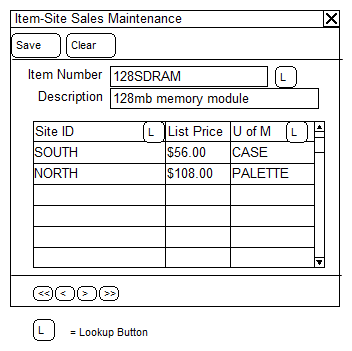
|
Field |
Function |
|
Location Code |
Enter a Location Code or select one from the Lookup. |
|
Item Number |
Enter an Item Number or select one from the Lookup. |
|
List Price |
Enter/modify the List Price for the Item in the selected Site. |
|
U of M |
Enter/modify the Default Selling U of M for the Item in the selected Site. NOTE: In Sales Transaction Entry, if the Default Selling U of M- Customer Price Level combination does not exist on the Item’s Price List, the “Default Selling U of M” from Item Price List Maintenance will be used. |
When opened from Item Maintenance, the Item Number and Description will be carried over to Item-Site Sales Maintenance from Item Maintenance.
If an Item-Site is not specified above, Sales Transaction Entry will use the normal “default” pricing and Selling Unit of Measure. If selling an Item in a Site needs either a different List Price or a different Unit of Measure, BOTH values must be provided above.
Sales Transaction Entry
There are no user interface changes.
In Sales Transaction Entry, and Sales Item Detail Entry:
Assumptions/Requirements:
For information about this design, or any other WilloWare customization or product, please contact us:
Release Date: 1-MAR-2023
GP Versions: 12/14/16/18
MFG Import Build: 3.62
* Changed Import Mapping (BOM and Routing) to allow multiple fields to reference the same source column in SQL, such as allowing the same column that has Item Number to be used for Item Number and Routing Name.
Virtual Trigger VT1151
Assembly Transaction- Change Assemble Quantity
Note: Virtual Triggers is a module from the WilloWare product Consulting Toolkit.
Virtual Triggers provides the ability to quickly enhance GP functionality with small bits of dexterity code.
Description of Need:
ACME uses the Dynamics GP Inventory Assembly transaction in food production. Due to the nature of working with food, there is variability in the quantity of the finished good regardless of the quantity of raw materials consumed. For example, given a certain amount of raw materials, the finished good output could be the desired quantity (i.e. 50 cases), or it could be slightly less or slightly more (49 or 51 cases).
ACME adjusts the Assembly Quantity to reflect the actual quantity produced.
However, when they do this, GP recalculates the raw material quantities and deletes any Lot Numbers selected for the raw materials, which means the user has to then re-select all of the raw material lots.
ACME would like a way to change the Assemble Quantity without losing raw material lot numbers.
Description of Solution:
The solution proposed is based on using WilloWare’s Virtual Triggers module in the Consulting Toolkit Suite. The cost of that module ($1000 + $180/yr Annual Enhancement) is NOT included in this estimate.
See more about Virtual Triggers here: //willoware.com/products/consulting-toolkit/#vt
WilloWare will create a Scriptlet, (a small bit of dexterity code,) which is imported into the Virtual Triggers module. The Scriptlet will add an Additional Menu option to the Assemble Entry window called “Change Assemble Quantity”. Selecting that menu option will:
After changing the quantity, the user can make adjustments to the finished good Lot Numbers, or Lot Quantity. NOTE: Assembly Entry will not allow the transaction to post if the finished good Lot Quantity does not match the Assemble Quantity.
Assumptions/Requirements:
For information on this Scriptlet, or any other Willoware customization or product, please contact us:
Release Date: 28-FEB-2023
GP Versions: 12/14/16/18
CompleteCount Build: 3.56
* Updated Excel interface to use a different method of reading data from Excel that prevents issues with trailing spaces, hidden columns, and cell formatting.
Customization DS1455
National Account Customer Transfer
Problem Definition:
ACME is a real estate company that manages brokers and agents. It is not
uncommon for an Agent to change from one Broker to another. In Dynamics GP, ACME manages the Broker-Agent relationships with the National Accounts functionality. Once a National Accounts relationship is created in GP, it does not easily allow changing a Customer from one NA to another.
ACME needs the ability to move customers between National Accounts.
ACME does not use Multi-currency or Project Accounting.
There may be open invoices for an Agent, and those should move with the Agent to the new
Broker. Partially paid and fully paid documents should remain with the previous Broker.
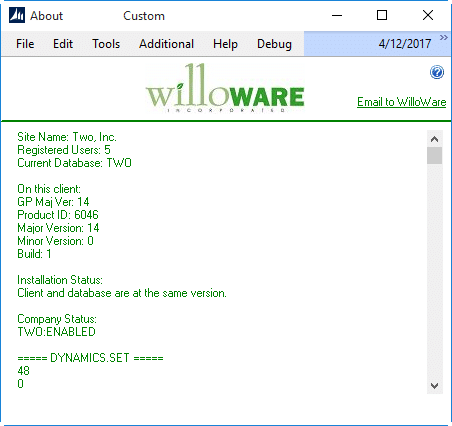
About
An About window for this product is available from:
Help>>About Dynamics GP>>Additional>>About Customization DS1455
Setup
Users must have access to the windows and reports in this product. The installation routine created a security task called WW_CUSTOM.
It will also create a new Security Role called WW_CUSTOM, and it will assign the WW_CUSTOM Security Task to an existing Role, or by assigning the WW_CUSTOM Security Role to a user.
Design Features:
NA Customer Transfer
In the National Accounts Maintenance window, select the NEW Broker. Add the Agent to the Broker. Instead of receiving a message that the “customer already exists in another national account relationship”, you will be asked if you want to transfer the customer from the old broker to the new one. If you answer yes, the customer will be added to the new Broker.
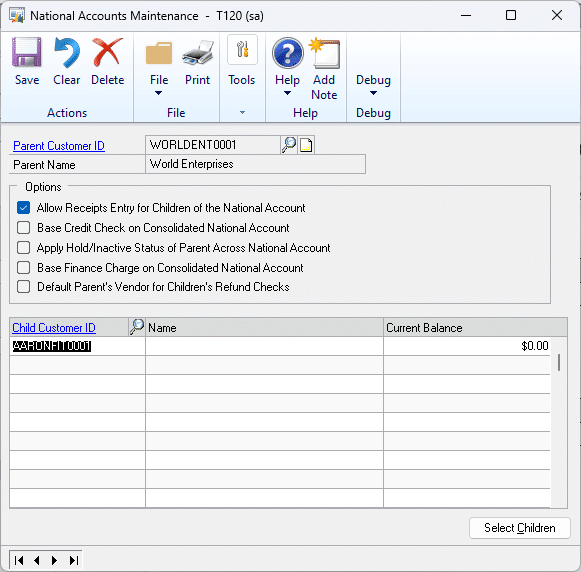
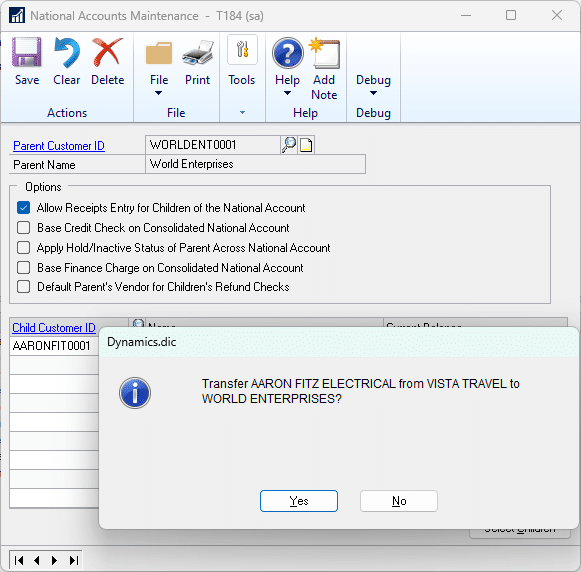
In the example above, AARONFIT0001 (the Agent) is being moved from VISTATRA0001 to WORLDENT0001. When asked to confirm the change, click YES.
Unpaid open Invoices for the Agent (AARONFIT0001) will be transferred to the new Broker. Complete and partially paid transactions will remain linked to the old Broker.
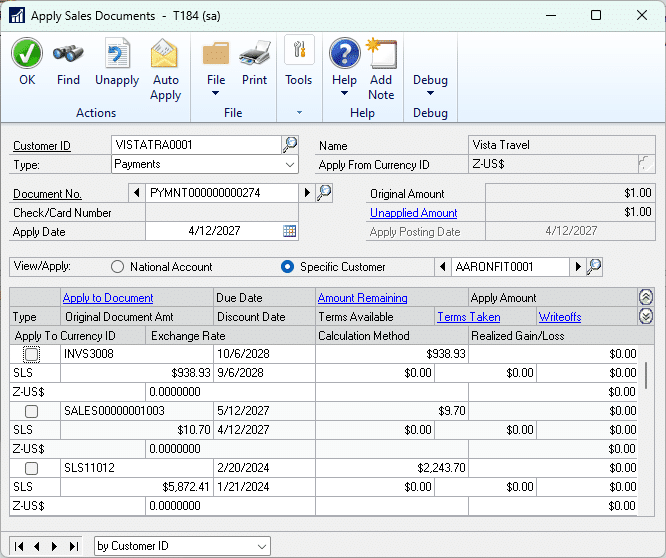
Payments from the old broker (VISTATRA0001) can still be applied to any partially paid invoices that had been partially paid by the old Broker (VISTATRA0001).
The Agent’s transactions will appear in the “National Account” view for the old Broker. You can also use “Specific Customer” to view only transactions for a specific Agent. Select “Specific Customer” and enter the Customer Number (AARONFIT0001). The Lookup will not show the Agent because that National Account relationship belongs to a different account.
WARNING! Do not DELETE the Customer from the National Accounts scrolling window. That will cause GP to remove the National Account information from every transaction for the Customer, both open and historical.
Assumptions/Requirements:
For Information about this design, or any other WilloWare customization or product, please contact us at:
Release Date: 20-FEB-2023
GP Versions: 12/14/16/18
MOGenerator Build: 4.115
* MOGenV2: (1) fixed issue in EditAllowed function that caused it to always return false, (2) fixed issue with the ApplyChanges routine that incorrectly returned an error that the End Quantity and Post To Site Are Not Allowed.
Release Date: 16-FEB-2023
GP Versions: 12/14/16/18
MFG PowerPack Build: 12.215
* SVC Equip Suite: (1) Changed setup to allow longer SOP Numbers but warn user that it reduces the possible configs per SOP Doc, (2) Rebuild Configs Utility: added check that a serial number was produced on an MO that has serial/lot linking before removing the existing config, (3) Equip Customer Change: from RMA Serials window it now asks users if they want to open the Equip Customer Change window rather than requiring it to be opened manually when the entered serial belongs to a different customer
* Sales Forecast Integration, Vendor Pricing Import, Proposed Cost Update, Serial Number Mass Entry, Item Copy: updated Excel communication to avoid issues casued by hidden columns, cell formatting, and regional settings
* Serial Number Mass Entry: addressed issue that was preventing adding serial numbers to SOP Returns
Release Date: 10-FEB-2023
GP Versions: 12/14/16/18
MFG Import Build: 3.61
* Addressed an issue that caused the import to bring in nulls/zeros when an Excel column included in the import was hidden in Excel. The import routine will now unhide hidden columns if they are included in the import.
Release Date: 9-FEB-2023
GP Versions: 12/14/16/18
MFG PowerPack Build: 12.214
* SVC Equipment Suite-Equipment Customer Change (ECC): addressed issue with ECC in the RMA Line Serial Numbers window where (1) the RMA Line Serial window will not allow entry of the serial number because it belongs to a different customer, and (2) the ECC window will not open without a serial number. The ECC window will now open with the Customer and Item Number only and allow the user to enter the serial number (#202300142).
Customization CR1350
Rolldown PO Required Date
Description of Need:
ACME often changes the required date on the purchase order header. When they do so, they need to manually update the required date on each line. Purchase orders can have up to 150 lines that require changing. ACME would like the option to rolldown the Required Date in a similar manner as the Promised Date.
Description of Solution:
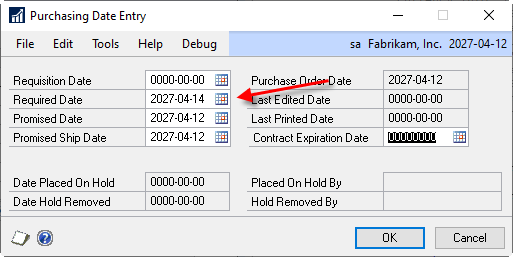
After the user updates the Required Date on the Purchasing Date Entry window and clicks OK to close it, they will be asked: “Do you want to roll down the changes to the required date to the line items?”. If the user answers YES, then the required date for each line item will be updated to match.
Assumptions/Requirements:
For information on this design, or any other WilloWare customization or product, please contact us:
Customization CR0955
Picklist PO Gen
Description of Need:
ACME can have several hundred new Manufacturing Orders at any given time. Some inventory replenishment is planned via MRP, but other items are purchased as needed when MOs are released and the Picklist indicates there are shortages. ACME has the “Allocate Inventory on Release” option marked in Manufacturing Setup, so GP attempts to allocate available inventory when each MO is released.
An existing customization (DS0803) addresses the need to create purchase orders for Picklist items that have shortages. However, since it works on a per-MO basis, it is time consuming to use with hundreds of MOs.
ACME needs to modify the utility to support creating POs for many MOs at one time.
Description of Solution:
Navigation: Transactions>>Manufacturing>>Picklist PO Generator. The window can also be opened for a single MO from Transactions>>Manufacturing Orders>>Pick List>>Additional>>PO Generator
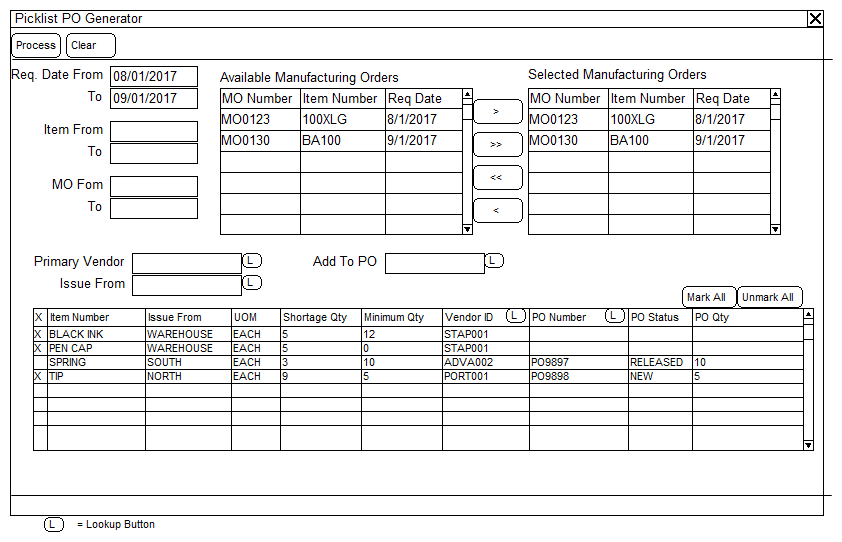
Range Restrictions:
Required Date, Item Number, and MO Number ranges are used to restrict which MOs are shown in the Available Manufacturing Orders window.
Required Date is the earliest Picklist Item Required Date, which could be the same as the MO Start Date, but the Picklist Required Date will account for any component lead times.
Item Number restricts Available MOs to only those where the Make Item is within the range.
MO Number restricts Available MOs to only those where the MO Number is within the range.
Changing any of the range values causes the Available MOs window to redisplay automatically.
Available Manufacturing Orders:
Available MOs can be moved to the Selected MOs window by clicking the > or >> buttons (Select One, Select All)
The “MO Number” column header is a Zoom which allows opening the MO in MO Entry.
Selected Manufacturing Orders:
When MOs are added to, or removed from, the Selected MOs window, the Picklist Shortages window redisplays (bottom scrolling window).
Picklist Shortages:
Displays one line for each Picklist line-item shortage.
Primary Vendor restricts the Shortages window to show only those lines that have the specified Primary Vendor.
Issue From restricts the Shortages window to show only the lines that have the specified Issue From Site ID.
Add to PO restricts the Shortages window to show only those lines that have an Item-Vendor record for the Vendor assigned to the selected PO. The window will only show Items that can be added to the selected PO without needing to create new Item-Vendor assignments.
Add a single requirement to a PO- A single Shortages line can be added to an existing PO by entering the PO Number into the PO Number field on the Shortage Line, (or select a PO from the PO Number Lookup.)
Important Changes from Current Picklist PO Generator:
PO Header “POP Contract Number” field will no longer be populated with the MO Number, since the requirements from multiple MOs could be consolidated into a single PO. The PO Line Comment will continue to contain the linked MO Number.
For information on this design, or any other WilloWare customization or product, please contact us at:
Customization DS0803
Auto-create PO from MO Pick List
Problem Definition:
ACME requires the ability to auto-generate Purchase Orders direct from Manufacturing Order Pick Lists for Buy Items with shortages that are not MRP planned for the Item/Site combination.
Purchase Order Lines should be consolidated if multiple lines share the same Vendor ID.
Design Features:
Navigation: Transactions >> Manufacturing Orders >> Pick List >>Additional >>PO Generator
From the Manufacturing Order Pick List, the user will navigate to Additional >>PO Generator. The MO Picklist Shortage PO Generator window will open if the MO Status is set to Released, Partially Received, Hold, Complete or Closed. The window will be view only if the MO Status is set to Hold, Complete, or Closed.
This window is used to create Purchase Orders for the MO Picklist shortages as well as to view previously created Purchase Orders.
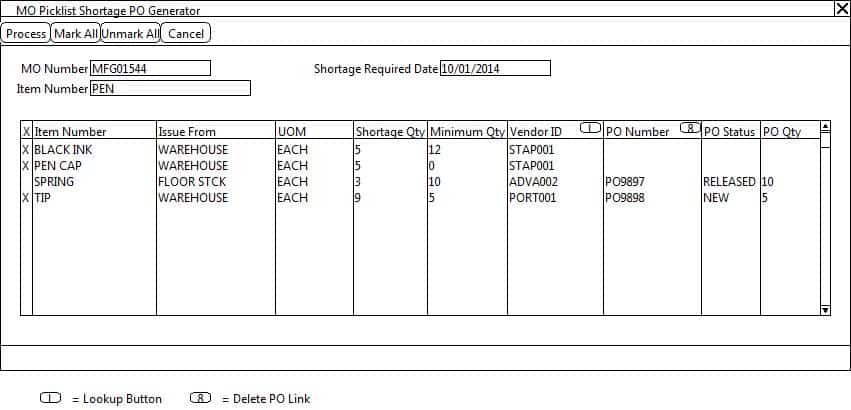
Please Note: Unless otherwise noted, all fields below are not editable.
|
Field |
Function |
|
Process |
The user will click the PROCESS button to generate or update Purchase Orders for all marked Item Numbers. Please see the section below entitled PROCESS BUTTON for more details. |
|
Mark All |
The use will click the MARK ALL button to mark all eligible Item Numbers in the scrolling window. An Item Number is considered eligible if:
|
|
Unmark All |
The user will click the UNMARK ALL button to unmark all Item Numbers in the scrolling window. |
|
X |
This field is a checkbox. The user will check the checkbox to mark an Item Number to be included in the PO Creation Process. An Item Number can only be marked if:
|
|
Item Number |
All Item Numbers on the MO Picklist matching the following criteria will display:
|
|
Issue From |
The Item Number’s Issue From Site ID from the MO Picklist will display. |
|
UOM |
The UOM from the MO Picklist for the Item Number will display. |
|
Shortage Qty |
The Shortage Qty will be set equal to the Item’s Picklist Required Qty. |
|
Minimum Qty |
The Minimum Qty for the Item Number/Site ID combination in the Item Resource Planning Card will display. |
|
Shortage Required Date |
The MO Start Date will display. |
|
Vendor ID |
The Last Order Vendor ID will default. The user may enter or select a Vendor ID from the lookup should a Last Order Vendor ID not exist or if they wish to change the Vendor ID. The user may NOT update the Vendor ID, if a Purchase Order is already linked to the Item Number. Please Note: The Vendor ID lookup will only display Vendor ID’s that are assigned to the Item Number. |
|
PO Number |
If a Purchase Order Number is already linked to the Item Number, the PO Number will display. Please Note: To delete a PO Link from a Picklist Line Item, select the Line Item and then click on the Link Button. The user will be prompted, “Do you want to break the link to PO XXXX?” If the user clicks NO, the enhancement will do nothing. If the user clicks YES, the enhancement will break the link. The Purchase Order itself will NOT be changed. Only the link to the MO Picklist will be removed. |
|
PO Status |
The linked Purchase Order Number’s status will display. |
|
PO Qty |
The linked Purchase Order Number’s Quantity Ordered will display. |
PROCESS BUTTON
When the user clicks the PROCESS BUTTON the enhancement will do the following for all Item Numbers that do NOT already have a linked PO Number:
When the user clicks the PROCESS BUTTON the enhancement will do the following for all Item Numbers that do already have a linked PO Number at Status NEW:
Please Note:
ACME should NOT delete Item Numbers from the MO Picklist. If an Item Number is NOT required, the Picklist Quantity should be updated to 0.
Assumptions/Requirements:
For information on this design, or any other WilloWare customization or product, please contact us at:
www.willoware.com/contact-me/
Release Date: 1-FEB-2023
GP Versions: 12/14/16/18
GP PowerPack Build: 7.166
* PO Doc IDs: addressed error message that appears when PO Doc IDs attempts to detect if WilloWare’s Blanket PO is installed (#202300102)
Release Date: 30-JAN-2023
GP Versions: 12/14/16/18
GP PowerPack Build: 7.165
* FAST Sales Serial Entry: addressed display issue that caused the Selected Serials scroll to fail to redisplay after cliking the Auto Select button (#202300094)
Customization CR1191
Project Maintenance- CRM Opportunity ID Control
Description of Need:
ACME stores a “CRM Opportunity ID” (CRMOID) in an Extender field on the Project Maintenance window. If the user has not already entered this value, the user should not be allowed out of the Project without entering the CRMOID.
Description of Solution:
When any action in the Project Maintenance window requires saving the record, the proposed enhancement will check if the CRMOID exists, and if not, the user will be warned:
“Please enter a CRM Opportunity ID.”
The attempt to “save” will be aborted and the user will then need to open the Extender window and enter the CRMOID. This will occur with any action that “saves” the Project, such as clicking the Save button, scrolling buttons, or Print button.
Assumptions/Requirements:
For Information on this design, or any other WilloWare customization or product, please contact us at:
Customization CR1191
Project Maintenance- CRM Opportunity ID Control
Description of Need:
ACME stores a “CRM Opportunity ID” (CRMOID) in an Extender field on the Project Maintenance window. If the user has not already entered this value, the user should not be allowed out of the Project without entering the CRMOID.
Description of Solution:
When any action in the Project Maintenance window requires saving the record, the proposed enhancement will check if the CRMOID exists, and if not, the user will be warned:
“Please enter a CRM Opportunity ID.”
The attempt to “save” will be aborted and the user will then need to open the Extender window and enter the CRMOID. This will occur with any action that “saves” the Project, such as clicking the Save button, scrolling buttons, or Print button.
Assumptions/Requirements:
For Information on this design, or any other WilloWare customization or product, please contact us at:
Customization DS1358
Contract Number Additional Field
Problem Definition:
ACME needs a Contract Number field added to the Receivables Transaction Entry and Bank Transaction Entry windows. The field needs to hold 50 characters that is not connected to another ID field within GP. This field does not need to be validated nor does it require a lookup.
The Contract Number must also be visible from the corresponding inquiry windows.
Solution Overview:
This solution will use a Virtual Field to add Contract Number to the requested windows.
Virtual Fields are added to windows at runtime and do not require modified or alternate forms. The Contract Number entered on the windows will be stored in a custom table with key fields to link back to the GP transaction tables.
The table will consist of the following fields:
Table Name: wContractNumbers
|
Field |
Description (* Indicates Key Field) |
|
Key String* |
Required Key Field. Since this table will be used for both Bank Transactions and RM Transactions, this field will contain EITHER the Customer Number for RM Transactions or Checkbook ID for Bank Transactions. |
|
Document Number* |
The Bank Transaction Number or RM Transaction Number. |
|
Document Type* |
The Document Type. Values will match those in the Bank Transactions table or RM Transactions table. |
|
Contract Number |
The 50 character string field that stores the contract number. |
Additional information regarding using the table for reporting is included in each section below.
Design Features:
Receivables Transaction Entry/Zoom
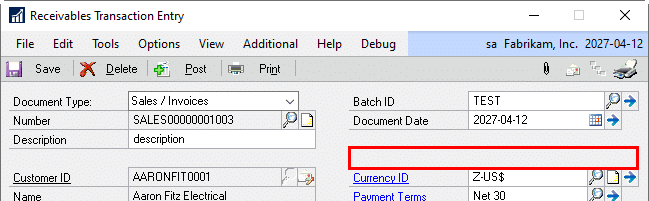
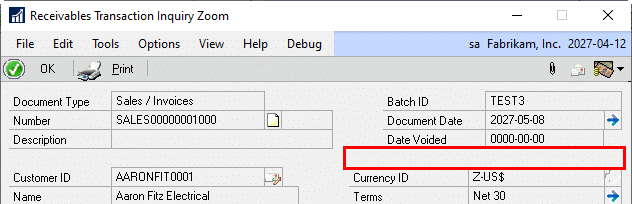
|
Field |
Function |
|
Contract Number |
50 Character field that will be added just above the existing Currency ID field. This field will be editable on the Entry window, view-only on the Zoom window. The value will be saved to the database when the user clicks SAVE. |
Table Name: wRMContractNumber
|
Field |
Description (* Indicates Key Field) |
|
Document Type* |
The Document Type |
|
Document Number* |
The RM Document Number |
|
Contract Number |
The 50 character string field that stores the contract number |
When a Receivables Transaction is created (and unposted), GP saves the record into the RM_Sales_WORK (SQL Name: RM10301) table. The primary key of this table is RM Document Type and RM Document Number. When a Contract Number needs to be entered, it will be saved to our custom table (wRMContractNumber).
The two tables can use the following relationship to be joined for reports that use the data in the RM_Sales_WORK table.
* Indicates Unique Record Key
|
RM_Sales_WORK |
wRMContractNumber |
|
|
RM Document Type-All* |
————– |
Document Type* |
|
RM_Document Number-WORK* |
————– |
Document Number* |
|
Customer Number |
Contract Number |
|
|
Etc. |
After the Receivables transaction is posted, the document is moved into the RM_OPEN (RM20101) table. A unique record can also be found using the RM Document Type and Document Number. Any reports referencing the RM_OPEN table can also use the custom table by using the following join:
|
RM_OPEN |
wRMContractNumber |
|
|
RM_Document Type-All* |
————– |
Document Type* |
|
RM_Document Number-WORK* |
————– |
Document Number* |
|
Customer Number |
Contract Number |
|
|
Etc. |
Bank Transaction Entry/Zoom
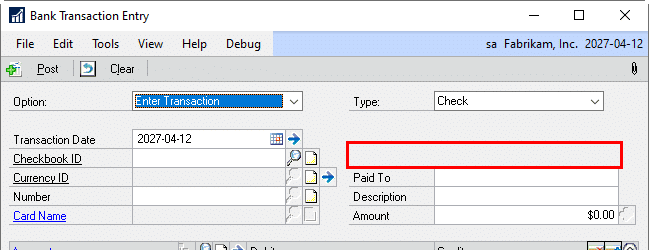
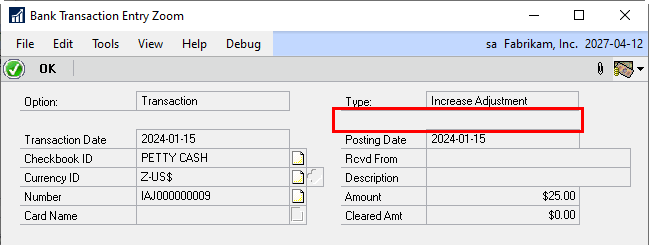
|
Field |
Function |
|
Contract Number |
50 Character field that will be added below the existing Type field. This field will be editable on the Entry window, view-only on the Zoom window. The value will be saved to the database when the user clicks POST. |
Table Name: wCMContractNumber
|
Field |
Description (*Indicates Key Field) |
|
Record Number* |
This is an auto-generated record number for the Bank Transaction. It is not displayed on the window but is a unique identifier for the record. |
|
Contract Number |
The 50 character string field that stores the contract number. |
When a Bank transaction is posted, GP saves the record into the CM_Transactions (SQL Name: CM20200) table or CM_Receipts (CM20300). The primary key of these tables is Record Number. When a Contract Number needs to be entered, it will be saved to our custom table (wCMContractNumber).
The tables can use the following relationship to be joined for reports that use the data in the CM_Transactions or CM_Receipts table.
* Indicates Unique Record Key
|
CM_Transactions |
wCMContractNumber |
|
|
Record Number* |
————– |
Record Number* |
|
CM Transaction Number |
Contract Number |
|
|
CM Transaction Type |
||
|
Etc. |
|
CM_Receipts |
wCMContractNumber |
|
|
Record Number* |
————– |
Record Number* |
|
Receipt Number |
Contract Number |
|
|
Receipt Type |
||
|
Etc. |
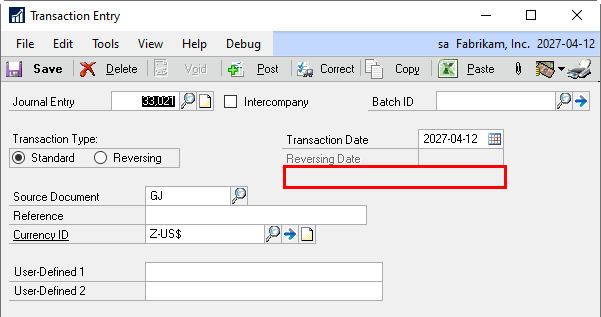
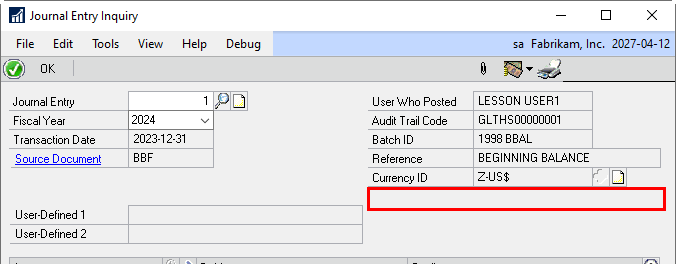
GP Transaction Entry/Zoom
|
Field |
Function |
|
Contract Number |
50 Character field that will be added below the existing Type field. This field will be editable on the Entry window, view-only on the Zoom window. The value will be saved to the database when the user clicks SAVE. |
Table Name: wGLContractNumber
|
Field |
Description (*Indicates Key Field) |
|
Journal Entry* |
The JE number from the transaction |
|
Contract Number |
The 50 character string field that stores the contract number. |
When a journal entry is saved, GP saves the record into the GL_TRX_HDR_WORK (SQL Name: GL10000) table. The primary key of this tables is Journal Entry. When a Contract Number needs to be entered, it will be saved to our custom table (wGLContractNumber).
The tables can use the following relationship to be joined for reports that use the data in the GL_TRX_HDR_WORK table.
* Indicates Unique Record Key
|
GL_TRX_HDR_WORK |
wCMContractNumber |
|
|
Journal Entry* |
—————- |
Journal Entry* |
|
Etc. |
Contract Number |
After the GL Transaction is posted, the document is moved into the GL_YTD_TRX_OPEN (GL20000) table. A unique record can also be found using the Journal Entry. Any reports referencing the GL_YTD_TRX_OPEN table can also use the custom table by using the following join:
|
GL_YTD_TRX_OPEN |
wCMContractNumber |
|
|
Journal Entry* |
—————– |
Journal Entry* |
|
Etc. |
Contract Number |
After the GL Transaction is moved to a historical year, the document is moved into the GL_YTD_TRX_HIST (GL30000) table. A unique record can also be found using the Journal Entry. Any reports referencing the GL_YTD_TRX_HIST table can also use the custom table by using the following join:
|
GL_YTD_TRX_HIST |
wCMContractNumber |
|
|
Journal Entry* |
—————– |
Journal Entry* |
|
Etc. |
Contract Number |
Assumptions/Requirements:
For Information on this design, or any other WilloWare customization or product, please contact us:
Release Date: 23-JAN-2023
GP Versions: 12/14/16/18
MOGenerator Build: 4.114
* MORI: fixed an issue with serial numbered phantoms that resulted in a “picklist shortage” error (#202201984)
Release Date: 17-JAN-2023
GP Versions: 12/14/16/18
MOGenerator Build: 4.113
* MORI: changes to accommodate “SQL Server Native Client Communication link failure”. Since GP can no longer communicate with the server when there is a network failure it is not possible to validate if an existing connection is still functional. When this error occurs the software will go into a loop attempting to create a new connection until it is successful, or the GP client is terminated.
Customization DS1070
Item-Country Security
Problem Definition:
Some ACME products are restricted by federal law from being sold to certain countries. ACME needs a way to track in GP which countries are prohibited for an item, and to prevent use of that item in Sales Transaction Entry if it is prohibited based on the Customer’s Ship to Address. The following controls are needed:
Solution Overview:
The Country Code field on Customer Maintenance, and Customer Address Maintenance, will store the Country Code for the address.
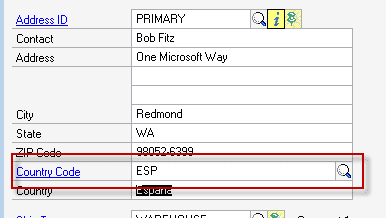
A new window will be added to assign “Prohibited” Countries to an Item.
Another window will be added to record a list of User IDs which are allowed to override a Bill-To-Disallowed & Ship-To-Allowed conflict.
In Sales Transaction Entry, the desired controls listed above will be applied to control which items can be used, and what changes can be made to the Ship To Address Code.
Design Features:
Navigation: Cards >> Inventory >> Item-Country, or from Item Maintenance >> Additional >> Item-Country Maintenance
This window is used to maintain the list of Country Codes to which the Item CANNOT be sold.
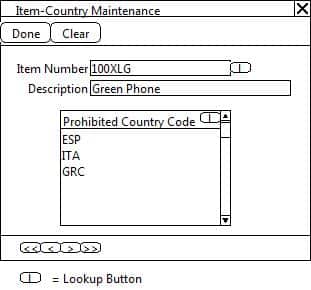
|
Field |
Function |
|
Item Number |
User enters an Item Number, or selects one from the Lookup |
|
Country Code |
User enters a Country Code, or selects one from the Lookup |
Approval User Setup:
Navigation: Setup >> Sales >> Approval User Setup
This window is used to maintain the list of Users who may approve a restricted Bill To Address Code with a non-restricted Ship To Address Code on a Sales Document.
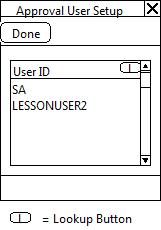
|
Field |
Function |
|
User ID |
User ID will be entered or selected from the Lookup. Only User ID’s entered will be granted privileges to approve Bill To Addresses with restricted Country Codes. The Password for each User ID will be their Dynamics GP Password. |
Sales Transaction Entry:
Require Country Code:
When creating a new Sales Transaction the enhancement will require that both the Bill To and Ship To Addresses have a Country Code. If either is blank, NO lines will be allowed on the transaction. The Bill To and Ship To cannot be changed on the Sales Transaction—all changes must be done on Customer Address Maintenance.
Lock Ship To Address Entry:
Navigation: Transactions >>Sales >> Sales Transaction Entry >> Sales Customer Detail Entry >> Sales Ship To Address Entry
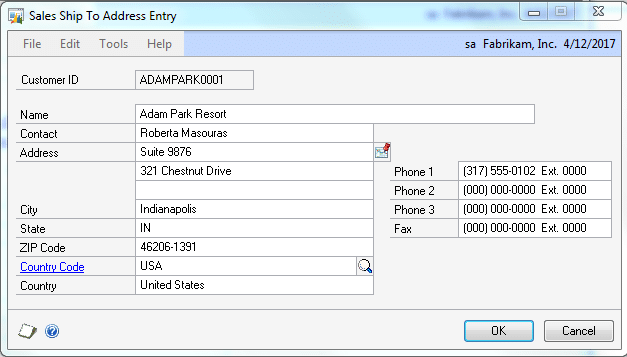
When the Sales Ship To Address Entry window is accessed from the Sales Document, all fields on the window will be locked and unable to be edited.
Control Change of Ship To Address Code:
There are two locations on a Sales Transaction where the Ship To Address Code can be changed:
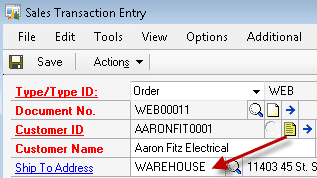
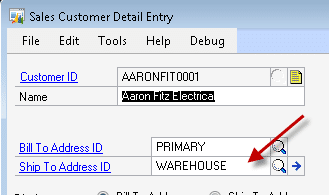
When the Ship To Address ID is changed in either of these locations, the system will check if the change is allowed. It is only allowed if the Country Code on the new Ship To does NOT conflict with any of the Item-Country assignments from the Item-Country Maintenance window. If the change is NOT allowed, the user will be warned and the Ship To Address ID will reset to the original value.
Item Entry Controls
Condition: Ship To- NOT ALLOWED
When an item is added to a Sales Transaction, the enhancement will check if the Ship To’s Country Code is prohibited for the Item. If so, the Item will not be allowed.
Condition: Ship To-ALLOWED, Bill To-ALLOWED
When an item is added to a Sales Transaction, the enhancement will check if the Ship To’s Country Code is prohibited for the Item. If not prohibited, it will next check if the Bill To’s Country Code is prohibited for the Item. If not, the Item will not be allowed.
Condition: Ship To-ALLOWED, Bill To-NOT ALLOWED
When an item is added to a Sales Transaction, the enhancement will check if the Ship To’s Country Code is prohibited for the Item. If not prohibited, it will next check if the Bill To’s Country Code is prohibited for the Item. If it is prohibited, the Override Entry window will open (see next Section).
SOP Line Ship To Address ID:
The Ship To Address ID field and Lookup will be disabled on the Sales Line. The Ship To cannot be changed on a per-line basis.
Override Entry:
When a user enters an item on a Sales Transaction where the Ship To Address Country Code is allowed, but the Bill To Address Country Code is restricted, the following window will open requiring a User ID and Password to continue:
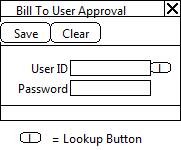
|
Field |
Function |
|
User ID |
User will enter or select their User ID from the Lookup |
|
Password |
User enters their corresponding Dynamics GP Passwork |
If an authorized user is not available to provide the override, or cannot provide the correct User ID and Password, the Item will NOT be allowed on the transaction. Once an Override is provided for a Transaction, it applies to all new lines added to the transaction (the Override is only provided once for the document). A record will be kept of which documents were overridden, by who, and when.
For information on this design, or any other WilloWare customization or product, please contact us at:
Customization DS1020
Sort RM Cash Apply by Document
Problem Definition:
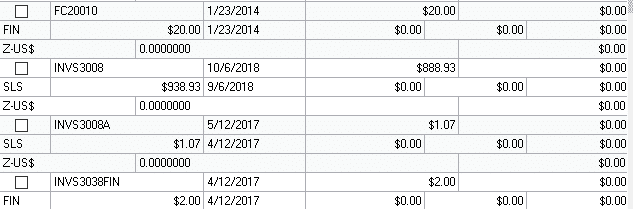
ACME enters an Invoice (i.e. 001234), and then may also add Debit Memos and/or Finance Charges using the Invoice Number as a prefix (i.e. 001234DM, 001234FC, etc.)
When they receive payment, it is difficult to find all of the related documents because the Apply Cash Receipts window sorts by Document Type and then Document Number.
ACME would like the window to sort by Document Number.
Solution Overview:
The Apply Cash Receipts window will sort automatically by Document Number.
Design Features:
Apply Cash Receipts
There is no user interface for this enhancement. The Apply Sales Documents scrolling window will sort by Document Number, then Document Type, so that all “related” Document Numbers are sorted together.
Assumptions/Requirements:
For information on this customization, or any other WilloWare customization or product, please contact us:
Release Date: 7-JAN-2023
GP Versions: 12/14/16/18
GP PowerPack Build: 7.164
* Updated API Key (see //willoware.com/lastpass-hack/)
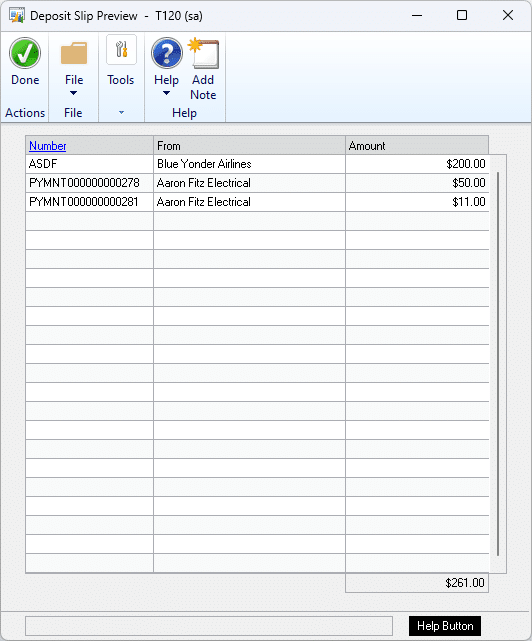
* Bank Deposit Filters: NEW- Added Deposit Slip Preview window that shows a list of only the cash receipts marked for deposit.
The new Deposit Slip Preview windows is an efficient way to quickly confirm the cash receipts you have marked for deposit. You can keep the Deposit Slip Preview window open while marking deposits, and it will refresh automatically as you mark receipts, so you can keep track of where you are in a pile of checks!
If you have not heard about the LastPass hack, you can find lots of information about it on the internet. Here is the nutshell:
We used LastPass at WilloWare. NONE of our customer data in the LastPass vault. But what it does contain is the API key our software uses to:
The old API key could, in theory, be used to access our Zendesk account and send phishing emails to our customers. This has NOT happened. To ensure it cannot happen we have deleted the old API key and will be including a new API key as we release new builds of our products and customizations.
Effectively immediately you will not be able to create a new case, submit error messages, or retrieve a new Registration Key through our software.
If you install an update to any of our products or customizations with a build date after 5-JAN-2023 it will have the new API key and normal functionality will return.
Customization DS1417
Additional Description Field on RM Transaction
Problem Definition:
ACME needs a second Description field added to the Receivables Transaction Entry. This field also needs to be accessible via SmartConnect.
Design Features:
WilloWare will use Virtual Fields to add an additional string field to Receivables Transaction Entry for the user to enter a second Description field. The field will be located in the following location and labeled Description 2. Due to limitations of Virtual Fields, this field cannot be included in the tab sequencing with the other fields.
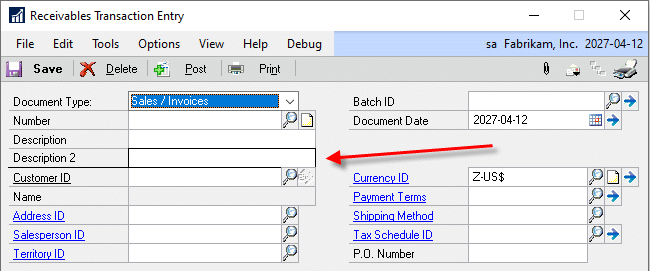
A matching field will also be added to Receivables Transaction Inquiry Zoom.
When a value is entered into this field and the transaction saved, the additional Description value will be saved to a custom table. This table can be joined to the RM Transaction table and will have the following fields:
Document Type – Integer. Key Field
Document Number – String. Key Field
Description 2 – 60 Character String Field
The name of the table will be provided by WilloWare so ACME can use it for importing and reporting.
Assumptions/Requirements:
For information about this design, or any other WilloWare customization or product, please contact us:
Release Date: 2-JAN-2023
GP Versions: 12/14/16/18
GP PowerPack Build: 6.163
* Bank Deposit Filters: addressed issue with Remote Desktop than can sometimes cause the Bank Deposit Entry/Bank Deposit Filters windows work not work correctly.
Customization DS1248
Certificate of Insurance
Problem Definition:
ACME needs to track which vendors must have a Certificate of Insurance and the Expiration Date of the Certificate. Additionally, when the Certificate expires, they need to have the Vendor automatically put on hold.
Solution Overview:
A new “Additional” window will be added to Vendor Maintenance which will be used to enter/maintain the Certification of Insurance Information.
A login routine will fire when the first user logs-in for the day. The routine will check for expired Certificates and put those vendors on hold.
Design Features:
Certificate of Insurance
Navigation: Vendor Maintenance >> Additional >> Cert. of Insurance
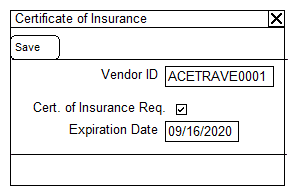
This window is used to enter/maintain/update a Vendor’s Certificate of Insurance information.
|
Field |
Function |
|
Vendor ID |
Displays the Vendor ID from Vendor Maintenance. A Vendor must be displayed in Vendor Maintenance before the Certificate of Insurance window will open. |
|
Cert. of Insurance Req. |
Mark this box to indicate that the Vendor must have a Certificate of Insurance. |
|
Expiration Date |
Enter the expiration date of the Certificate of Insurance. |
Vendor Hold
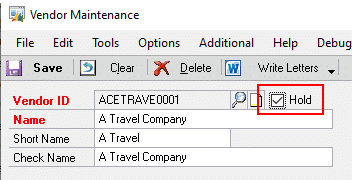
The first user to log-in to GP each day will trigger a routine that puts Vendors on HOLD if they are required to have a COI and its Expiration Date has passed (i.e. Expiration Date < today).
Assumptions/Requirements:
For information on this customization, or any other WilloWare customization or product, please contact us at:
Release Date: 20-DEC-2022
GP Versions: 12/14/16/18
MFG PowerPack Build: 12.212
* Item Class Serial/Lot Mask: fixed issue with Rolldown & Sync routines that caused it to incorrectly identify a “max serial number” that was from the the LastGenSN of items in the item class and not from the Template Item
Customization DS1320
Vendor Contract Pricing
Problem Definition:
While testing WilloWare’s Vendor Pricing module prior to purchasing and implementing it, ACME uncovered several requirements that could not be met by the module, and WilloWare determined that it would not be cost effective to modify the core product to address these requirements. Specifically, ACME needs to maintain the Vendor Pricing as a “Contract” and capture additional information pertaining to each contract, and they need pricing to be determined based on the Required Date rather than the Release Date.
ACME needs to report on the Quantity Limit on a contract, the Quantity currently on PO, and the Quantity Received. There needs to be a clear link between the Contract and the PO Lines created based on that Contract. Reporting will be created by RBC and/or their Partner.
One of the required Contract fields is “Threshold Percent”. When the total quantity on PO is within a specified percentage of the Contract Total Quantity (say 5%) it triggers warnings and alert emails, as follows:
The conditions above could result in multiple warning conditions. When that happens, the warning should provide the user with both.
The Threshold Percent and the Notifications Email Addresses will be stored in GP, but email alert will be handled via a SQL job created by ACME and/or their Partner.
The “warnings” mentioned above will be displayed inside Dynamics GP.
See the Solution Description section for the Contract fields.
Design Features:
Contract Maintenance
Navigation: Cards >> Purchasing >> Contract Maintenance
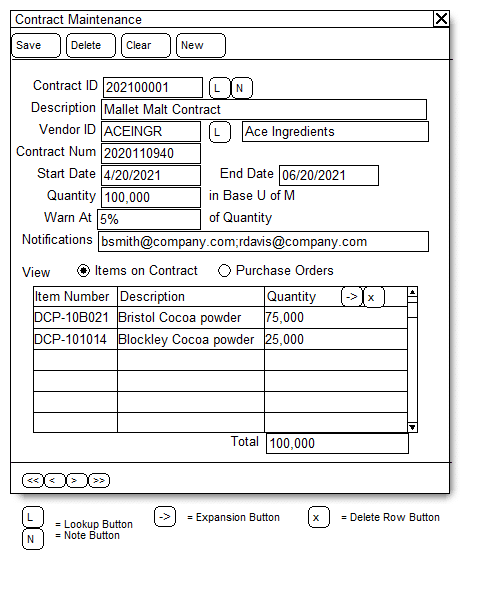
|
Field |
Function |
|
Contract ID |
Start a new contract by creating new Contract ID. Click the NEW button to have the system auto-generate a new Contract ID. The Contract ID will be created using the 4-digit year and an incrementing number. For example: 202200001. This is a required field. |
|
Description |
Enter a description for the contract |
|
Vendor ID |
Enter a Vendor ID or select one from the lookup. This field is required. |
|
Contract Number |
Enter the Contract Number from the contract document provided by the Vendor. |
|
Start Date/End Date |
Enter the Start/End Dates for the contract. Both are required and End Date must come after Start Date. See Start Date/End Date controls below. |
|
Quantity |
Enter the contract quantity. Quantity needs to be greater than zero. This is a required field. |
|
Warning Threshold |
The percentage entered here affects when warnings appear in GP. For example, 5% will cause a warning to appear when adding an item to a PO and the quantity will bring the total ordered on the contract to within 5% of the Contract Total Quantity. 0% will cause no warnings to appear until the Total Quantity is reached/exceeded. |
|
Notifications |
Enter one or more emails for people to be notified when the Warning Threshold is reached and when the Contract Total Quantity is reached/exceeded. |
|
VIEW |
Items on Contract or Purchase Orders. See below for more details. |
|
SAVE |
Saves the Contract and clears the window. |
|
DELETE |
Asks user: Do you want to delete this contract and all linked Vendor Price Lists? If the user answers YES, the contract and all linked price lists will be deleted. |
|
CLEAR |
Clears the window without saving changes. NOTE: date changes are saved to the Contract and linked Vendor Price Lists immediately. Clicking Clear after a date change does not undo the date change. |
|
NEW |
Creates a new Contract ID |
|
DELETE ROW |
If a Vendor Price List is attached, the user will be ask: Do you want to remove this line and delete the linked Vendor Price List? If the user answers YES, the line will be removed and the price list deleted. If no price list is linked, the line will be deleted without prompting. |
|
NOTE |
Clicking the Note button opens up a window where the paperclip opens the Doc Attach window. This will allow ACME to attach scans of the Contracts to the Contract in GP. |
When creating a new contract, as an item is added to the contract, the software will check that it does not conflict with another contract for the same Item and same Vendor. For example, if the new contract is for APR-1 to JUN-30, and the user enters ITEM-A, but that Vendor already has a contract for ITEM-A with a period of JAN-1 to JUN-30, the user will be warned of the overlap and prevented from using the item. An item can only be added to a contract when there is no overlap between contract start/end date for the same Item-Vendor.
When changing dates, the software will perform a check to ensure the date change would not overlap with an existing contract. Changing dates on an existing Contract will primarily occur if the Contract Total Quantity has not been reached and they extend the End Date to finishing consuming the total quantity. The check will be performed as follows:
1. Does the Vendor have any other Contracts where the new date falls with the Start/End dates of the contract? If not, then the change is allowed. If so, then:
2. Does the contract have ANY items in common with the current contract? If not, then the change is allowed. If so, the user will be warned as follows:
“Contract ID 202100003 / Contract Number 20209902231 has conflicting Start/End Dates. The date change is not allowed.”
At that point the date will revert to the original value.
If a date change is allowed, and if Price Lists exists in Vendor Pricing Maintenance for the Contract, changing the Start/End Dates will prompt the user: Do you want to change the Start/End Date on all linked Vendor Price Lists? If the user answers YES, the new date will be rolled down to all linked Vendor Price Lists. If the user answers NO, the date will revert to its original value.
To create a Vendor Price List for the contract, first add one or more Items to the contract. Items must be added to the contract before pricing can be created.
Specify the Quantity you expect to purchase of each item. The window will ensure that the total quantity entered for all items equals the Contract Total Quantity. You will not be allowed to save the contract or exit the window until the Item Quantity matches the Total Quantity. Attempting to Save, Clear, Scroll, Lookup, etc will be prevented, and the user warned, until the quantities match.
If there are NO items on the contract, the contract can be saved with whatever Contract Total Quantity has been entered.
After entering one or more items, click on an item, then click the Expansion Button (blue arrow) to open the Vendor Pricing window.
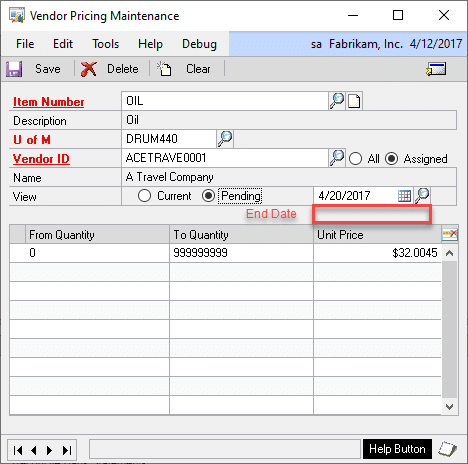
The Vendor Pricing Maintenance window will default to the Default Purchasing U of M. Item Number and Vendor ID will be populated automatically based on the Contract. Start Date and End Date will also default from the Contract and will be locked.
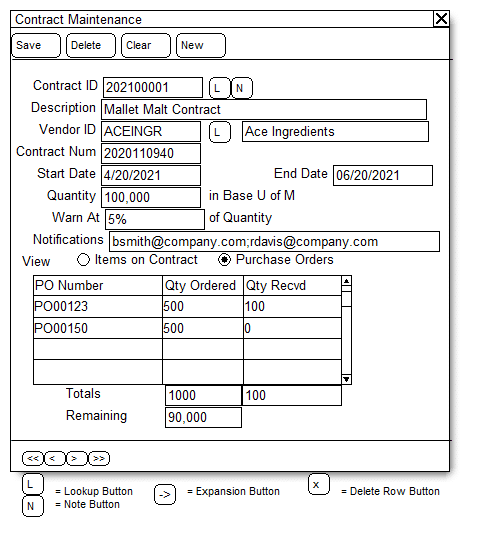
When PO’s have been created based on the Contract, they will appear here in the Purchase Orders view. Click on a row in the window, then click the PO Number zoom (PO Number column header) to open the PO in the PO Entry window.
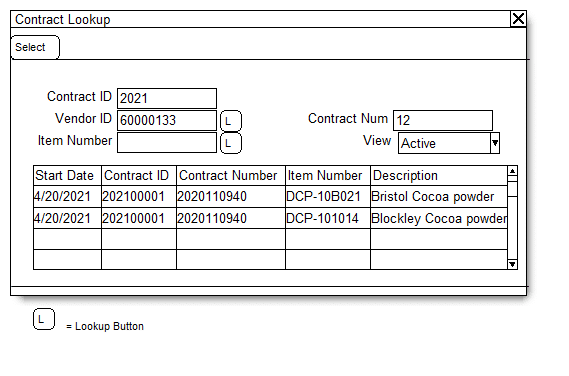
Opens from the Lookup button next to Contract ID.
|
Field |
Function |
|
Contract ID |
Defaults to whatever portion of the Contract ID was entered on the Contract Maintenance window. This field will restrict the window to all contracts that contain the value entered into the Vendor ID field. For example, entering “2021” will display all contracts where the Contract ID contains “2021”. |
|
Vendor ID |
Enter a Vendor ID, or a portion of a Vendor ID. This will restrict the window to all contracts that contain the value entered in the Vendor ID field. For example, entering “33” will return all contracts where the Vendor ID contains 33. |
|
Item Number |
Enter an Item Number, or a portion of an Item Number. This will restrict the window to all contracts that contain the value entered in the Item Number field. For example, entering “DCP” will return all contracts that are for an Item Number containing “DCP”. |
|
Contract Num |
Enter a Contract Number, or a portion of a Contract Number. This will restrict the window to all contracts that contain the value entered in the Contract Number field. For example, entering “940” will return all contracts that have a Contract Number containing “940”. |
|
View |
Options are ACTIVE and ALL. Active shows only contracts with a Start Date on or after today. All shows all contracts. |
Any of the fields at the top of the window can be used alone, or in combination, to restrict the list of contracts displayed.
Controls and Enhancements
See the Problem Definition section for the conditions that will cause warnings to be displayed, and the language used on the warnings. This is referred to below as the Warning Conditions. The warnings will appear in the following locations:
The Vendor Pricing Inquiry window will be modified to have a large “status” box at the bottom of the window. The warning will be displayed in a YELLOW BOX at the bottom of the window with bold black text. When the focus is in a line in the PO Generator window, and purchasing the item would trigger a Warning Condition, the warning message will be displayed at the bottom of the Vendor Pricing Inquiry window. The Vendor Pricing Inquiry window will be modified to display the Contract NUMBER.
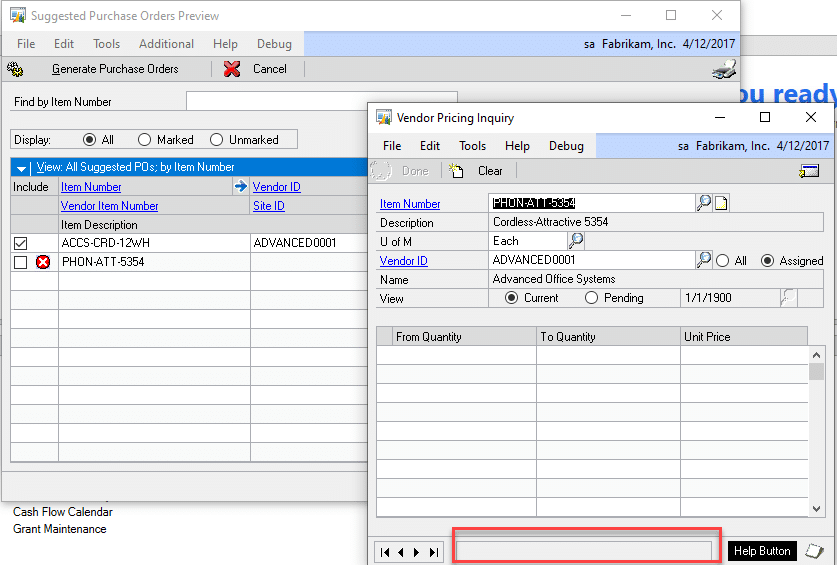
NOTE: The GoTo button will include an option that provides access to the Contract Maintenance window.
The Select Cost window will be modified to have a large “status” box at the bottom of the window. The warning will be displayed in a YELLOW BOX at the bottom of the window with bold black text. When the focus is in a line in the PRR window, and purchasing the item would trigger a Warning Condition, the warning message will be displayed at the bottom of the Select Cost window. The Select Cost window will be modified to display the Contract NUMBER on the expanded scroll window line (i.e. next to Vendor Name).
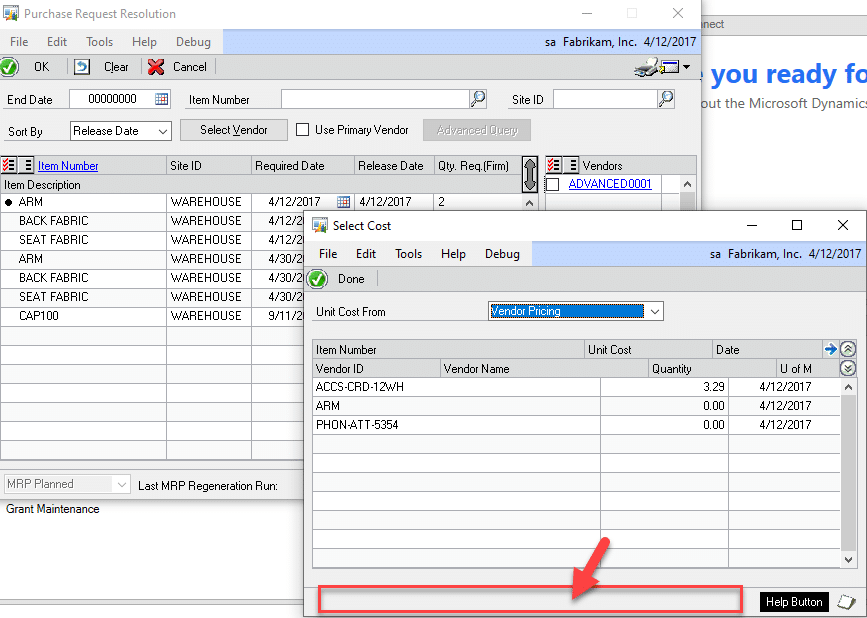
NOTE: A GoTo button will be added to the Select Cost window to provide access to the Control Maintenance window.
The Vendor Pricing Inquiry window will be modified to have a large “status” box at the bottom of the window. The warning will be displayed in a YELLOW BOX at the bottom of the window with bold black text. When the focus is in a line in the PO Entry window, and purchasing the item would trigger a Warning Condition, the warning message will be displayed at the bottom of the Vendor Pricing Inquiry window.
The Vendor Pricing Inquiry window will be modified to display the Contract NUMBER.
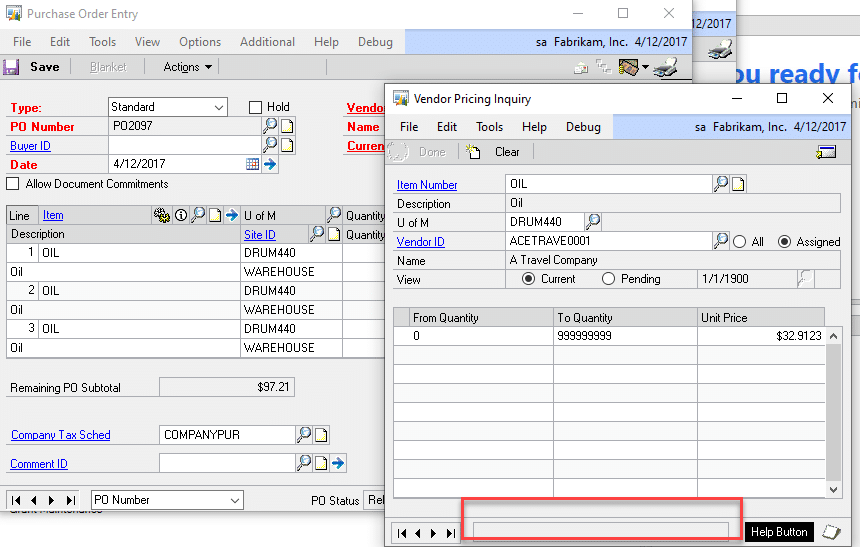
Changing the Quantity on the PO Line may cause the warning to appear, or disappear, if the quantity causes the Warning Condition to alter.
NOTE: The GoTo button will include an option that provides access to the Contract Maintenance window.
When a PO Line is created, regardless of the source (i.e. PO Generator, Purchase Request Resolution, or PO Entry), the enhancement will link the PO Line to the Contract (assuming the item is contracted. This does not apply to non-contracted items). The software will always link a PO Link to the contract from which it was created. Even if the Contract Total Quantity has been consumed, and/or the End Date has passed. Such conditions are not normal and will result in the warnings and emails previously covered.
The linking is important because the links allow a calculation of the total quantity ordered on a Contract. Creating the link implicitly means the PO Line Quantity will be subtracted from the linked Contract Total Quantity.
The linking will occur as follows:
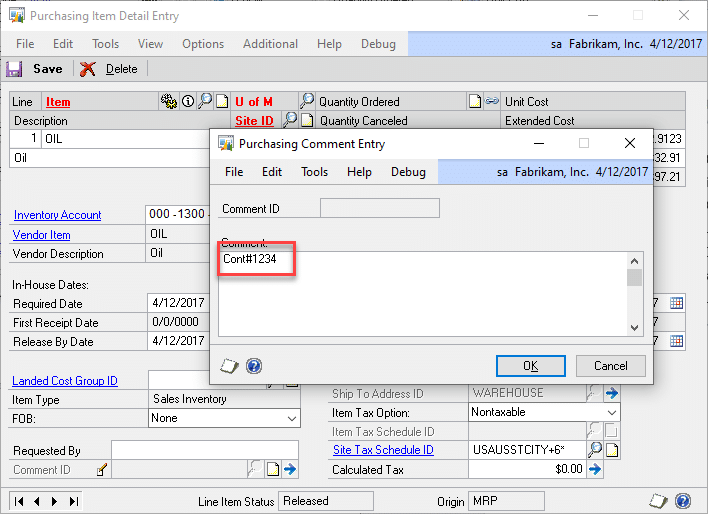
Putting the Contract NUMBER into this location will cause it to print on GP reports. If needed, ACME can add additional text below the Contract NUMBER line to have additional information print on the report.
Vendor Pricing
The Vendor Pricing will be changed to use REQUIRED Date rather than Release Date.
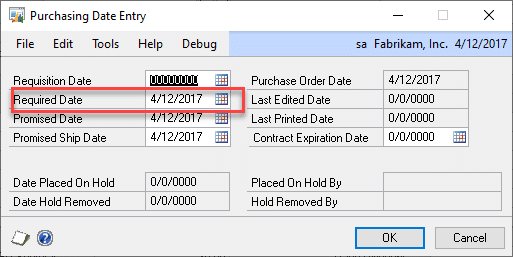
Assumptions/Requirements
For Information on this customization, or any other WilloWare customization or product, please contact us at:
Release Date: 15-DEC-2022
GP Versions: 12/14/16/18
MFG PowerPack Build: 12.211
* Serial Number Mass Entry: The paste field has a limit of 32,000 characters. To insert a very large number of serials, a user would need to paste close to the capacity of the window, insert, then repeat the process. This build addresses an error where subsequent paste/insert would generate a duplicate key error. (#202202385)
Release Date: 12-DEC-2022
GP Versions: 12/14/16/18
MFG Import Build: 3.59
* Routing Import: (1) Added ability to export Map, (2) Fixed issue with import from excel where an error occurred because it was incorrectly attempting to execute a status update that occurs with SQL table imports.
* BOM Import: Updated the Map Export routine so it provides the default value used then the field map is “Default”
Release Date: 8-DEC-2022
GP Versions: 12/14/16/18
MFG PowerPack Build: 12.210
* PowerATP: addressed issue with Item Number zoom that did not correctly identify the Security Role POWERUSER so it could not open Item Maintenance or Item Inquiry (#202202316). However, this issue was not specific to the PowerATP window, any Item Number zoom in MFG PowerPack would have experienced the same issue, as will several other zooms.
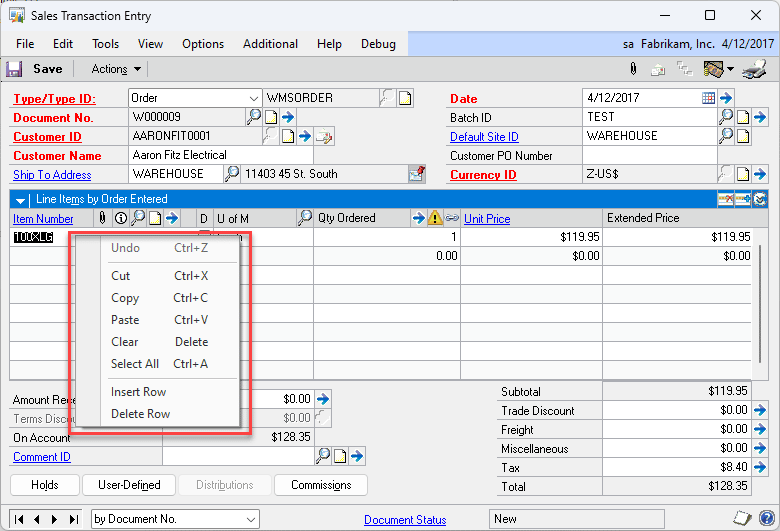
* NEW TWEAK-Turn off Job Cost Menus: this turns off the Job Costing right-click menus which allows GP to again display the normal right-click menu to Insert Row, Delete Row, Copy, etc.
Job Cost Menus ON:
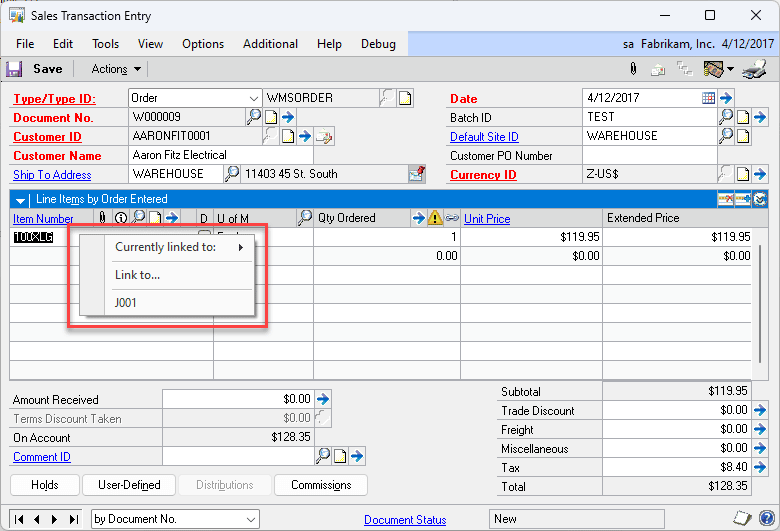
Job Cost Menus OFF:
Release Date: 7-DEC-2022
GP Versions: 12/14/16/18
CTK Build: 2.31
* Updated for GP18.5 Release
Release Date: 6-DEC-2022
GP Versions: 12/14/16/18
MOGenerator Build: 4.111
* MORI: “Check for Shortages”–fixed an issue in this routine that was not accounting for phantoms and therefore giving an inaccurate “picklist shortage” error when non existed. (#202201984)
Customization DS1394
PO Generator Enhancements
Problem Definition:
ACME would like to add the following functionality to the PO Generator windows:
Generator Preview window.
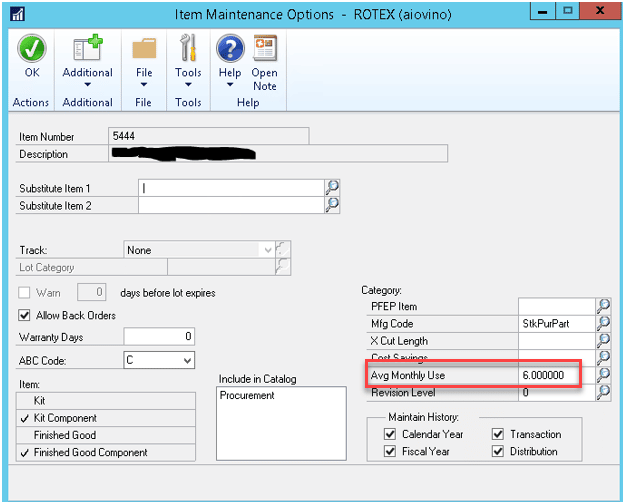
Additionally, ACME would like to be able to identify which POs came from PO Generator and have them automatically put On Hold until reviewed by a user.
Design Features:
PO Generator Enhancements
Navigation: from either the Suggested PO Preview window, or the Suggested PO Detail window, select Additional >> Add/Edit Note
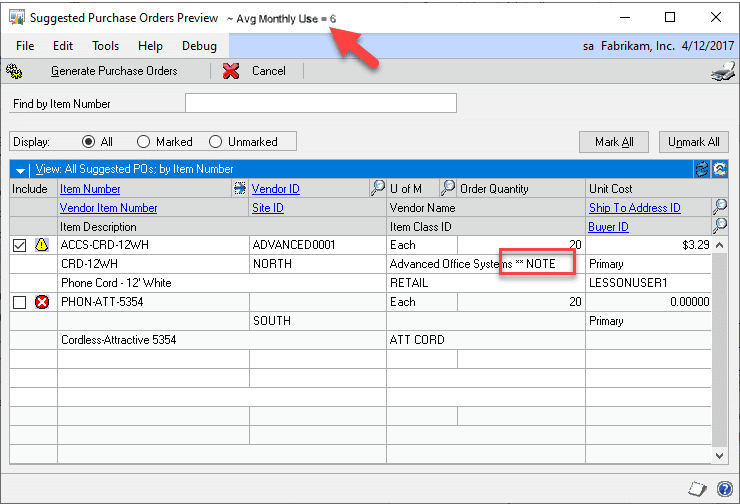
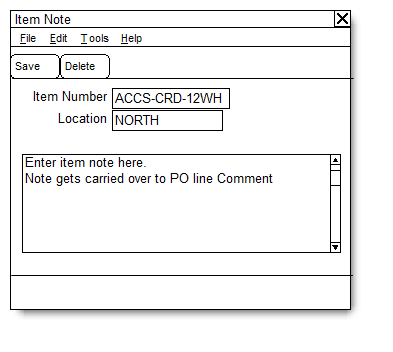
A window will open where you can enter a note (up to 500 characters, the PO Line Comment is limited to 500 characters). Once a note has been added, the Vendor Name field will show “** NOTE”—this change is on the user interface only and will not affect the Vendor Master or the Purchase Order (“**NOTE” will NOT flow through to the PO).
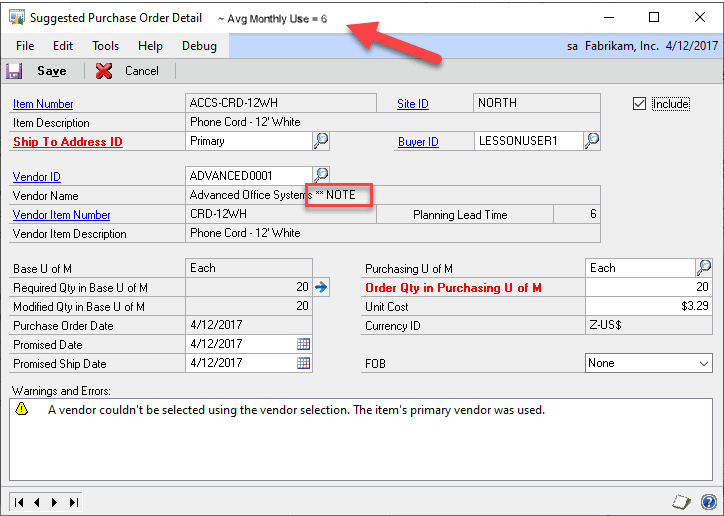
The Average Monthly Use quantity for an Item will be displayed in the Title Bar of the windows. In the PO Generator Preview window the Avg Monthly Use quantity will change when different lines are selected.
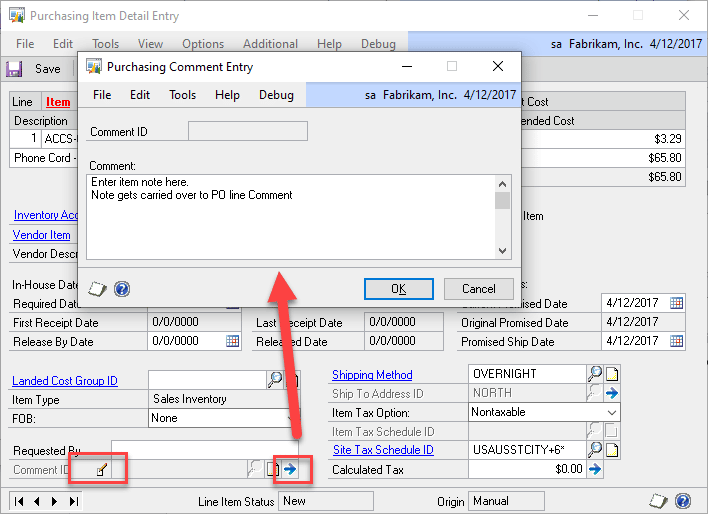
The PO Generator Item Note will be carried over to the PO Line Comment when a PO is created.
Purchase Orders created from PO Generator will automatically have the HOLD flag set on the PO. Doing this will have update the following fields in the PO Header (POP10100):
To ensure that POs created by PO Generator can be pulled into a SmartList, the USER2ENT field in the PO Header (POP10100) will be set to POGEN. This does NOT need to exist as a User ID in GP.
Assumptions/Requirements:
For Information on this Design, or any other WilloWare customization or product, please contact us at:
Release Date: 30-NOV-2022
GP Versions: 12/14/16/18
MFG PowerPack Build: 12.209
* Serial Number Mass Entry: Added support for FAST Sales Serial Entry in GP PowerPack
Release Date: 22-NOV-2022
GP Versions: 12/14/16/18
MFG PowerPack Build: 12.208
* SOP Backorder All: added support “Quote to Order” transfer so that the Order is created with all quantities backordered.
Customization DS1438
SOP Invoice Lines from List
Problem Definition:
ACME is using WilloWare’s SOP-POP Multi-Link module. (SOP-POP MultiLink (willoware.com)
They have Sales Orders with several lines, and as the sales lines are received, SOP-POP Multi-Link automatically moves the quantity bucket form Qty to Back Order to Qty to Invoice. ACME needs the ability to specify which lines get transferred to invoice.
Solution Overview:
This enhancement will be active from the Sales Transfer Documents window when accessed from Sales Transaction Entry (not Sales Batch Entry)
Navigation: Sales Transaction Entry >> Transfer Action Button
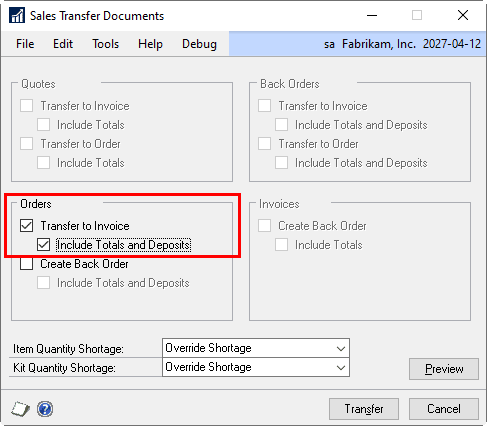
The enhancement will only be active when transferring an Order to an Invoice. See next section for more details.
Design Features:
SOP Transfer Line Selection
Navigation: Sales Transfer Documents>> Additional >> Transfer Line Selection
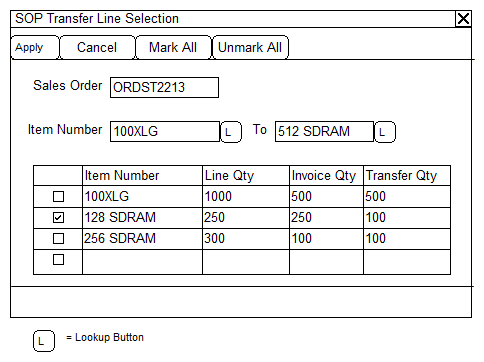
By default, GP will transfer ALL lines that are eligible to be invoiced to a single invoice. The SOP Transfer Line Selection window will allow ACME to select only specific lines and quantities to be transferred. If this window is not used during the transfer process, then all lines will be transferred (default behavior).
|
Field |
Function |
|
APPLY |
Sends the marked/unmarked status back to the sales order. If APPLY is not clicked, then any changes made will not be applied. |
|
CANCEL |
Closes the window without making changes. |
|
MARK All |
Marks all lines in the window. |
|
UNMARK ALL |
Unmarks all lines in the window. |
|
Sales Order |
Displays the sales order being transferred. |
|
Item Number From/To |
Allows the user to enter an item number or a range of item numbers to filter the list. |
|
Scrolling Window |
Displays all the sales lines with a Qty to Invoice > 0. By default, all lines will be unmarked. Use the checkbox to indicate the line should be transferred. |
|
Transfer Qty |
This is the quantity that will be transferred to invoice. By default, this value will be the maximum amount (Invoice Qty), but can be reduced if only part of the line is to be transferred. Partially transferring a line will allow the line to be transferred multiple times until all the Qty to Invoice has been transferred. |
If lines have been marked, the Sales Transfer Documents title bar will be updated to include the text
“ – Sales Line Selections”.
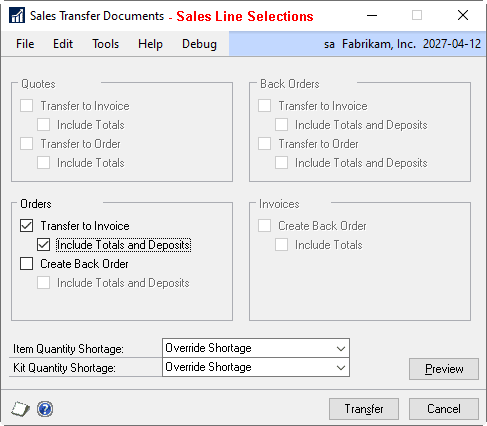
When the user clicks TRANSFER, only line quantities marked will be moved to invoice.
For Information regarding this customization, or any other WilloWare customization or product module, please contact us at:
Release Date: 15-NOV-2022
GP Versions: 12/14/16/18
MFG PowerPack Build: 12.207
* Serial Number Mass Entry: (1) changed POP and SOP serial entry to use direct to table SQL updates to optimize speed, (2) Added Excel import
Release Date: 12-NOV-2022
GP Versions: 12/14/16/18
GP PowerPack Build: 6.162
* NEW * FAST Sales Serial Entry: Replaces the Sales Serial Entry window with one that is FAST with large quantities of serial numbers. It has Serial Number and Bin search fields that allow locating records using “contains”, “begins with” and “ends with” search (plus other options). Select multiple serial numbers by “marking” them, rather than having to click on the serial number and then click insert.
FAST Sales Serial Entry replaces the standard Dynamics GP Sales Serial Entry window with one that can easily handle very large number of serial numbers. In GP2013 Microsoft added the ability to “multi-select” serial numbers which required changing the “Available Serial Numbers” scrolling window to a list view window. A list view is similar to the SmartList window, it allows multi-select but it is very slow to fill with data. If you have several hundred serial number, or more, the standard Sales Serial Entry window takes a very long time to open because the list of Available Serial Numbers needs to populate first with ALL serial numbers.
The FAST Sales Serial Entry window replaces the list views with scrolling windows which are very quick to load. The FAST Sales Serial Entry also provides:
The window will open automatically instead of the standard GP Sales Serial Number Entry window. It works with Sales Transaction Entry and Sales Separate Fulfillment.
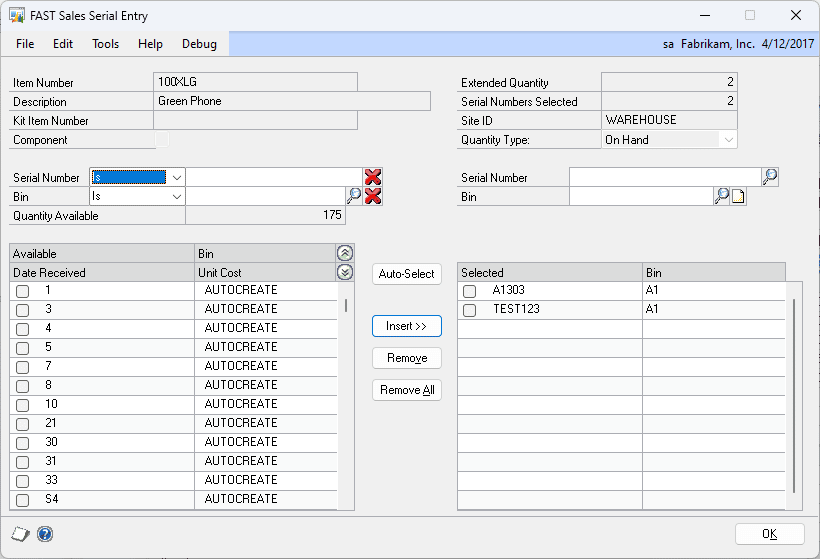
Serial Number Search: Choose a search operation (Is, Is not, Contains, etc), then enter a search term and press the TAB key. The Available Serials window will redisplay. Click the red X to clear the field and refresh the list.
Bin Search: Choose a search operation (Is, Is not, Contains, etc), then enter a search term and press the TAB key. The Available Serials window will redisplay. Click the red X to clear the field and refresh the list.
Auto Select: Auto Select will pick the number of needed serial numbers based on the Item’s Valuation Method. For example, LIFO will pick serials from the bottom of the list first where FIFO will pick from the top of the list.
Release Date: 11-NOV-2022
GP Versions: 12/14/16/18
MFG Import Build: 3.58
* BOM Import: (1) fixed issue with Valuation Method validation that was preventing import of standard cost components into an actual cost finished good. (2) added ability to export the BOM ImportMap setup (see GoTo Button on Import Map Setup)
Release Date: 8-NOV-2022
GP Versions: 12/14/16/18
MOGenerator Build: 4.110
* MORI: (1) Now truncates the error log (note) at the bottom (oldest errors) for an MO if it reaches the maximum length of a note, and then it continues to add new errors to the top, (2) Added check for a locked BOM before attempting to process an MO Receipt, (3) Added a new “next MO” selection routine that is entirely SQL based to reduce the possibility of collisions between two GP client processors.
Yes.
There are tens of thousands of GP users poking around every nook and cranny of the software every day. Every release contains not only new features, but bug fixes. Even after decades of heavy use people are still able to come up with unique things to do to the software that shake out a previously unknown issue, and Microsoft fixes it.
A bit off topic for this post…but consider for a moment the implication of usage history (or lack thereof) with a newer ERP package.
A major benefit of Annual Enhancement is being able to get the latest version of the software which includes new features that you may use, and fixes that may be relevant to you now and perhaps ones you WILL wish you had in the future if you postponed updating.
A few years back WilloWare changed our build numbering logic to what we call a “unified build number”. In the past, each build of our software for each GP Major version had its own build number. For example, GP PowerPack would have looked like this:
We have always maintained ONE code base for ALL GP versions, and within that one code base were all of the options needed to make it work on the different versions of GP. If something was different in GP2016 versus GP2018 we would add “switches” in our software so it could figure out which version of GP was in use and use the correct version of its code to be compatible with the version of GP.
The single code base means that new features and fixes are available across all supported versions of GP (currently we’re still supporting GP2013). To reflect this, we started using one build number across all versions of GP. We compile the code separately for each GP major version and that is shown in the first part of the build number (i.e. “12”). The next two numbers are internal. For example:
The “2.138” is our internal build. “2” will change to “3” if there are SQL object changes, and the final number always increments with each release (so “138” to “139”).
We just completed updating all of our products for GP18.5, and the ReadMe file for the products will note something like “Updated for GP18.5 Release”. Does this mean it only has changes relevant to GP18.5? No.
Our products have a large amount of “common” code–it is the same in every product. If you open the About window for one of our products, at the bottom you will see a section like this:
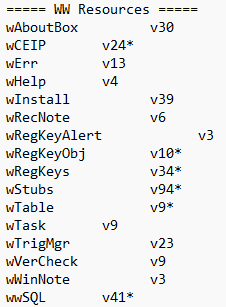
This is reporting on the state of our internal reusable code modules and the asterisk indicates there is a newer version of that module. The WW Resources are how our products interact with GP and SQL Server. For example, they control how we open a window, or execute a query in the database.
We have so many users hammering away in GP and our products that they find things, and we try to fix or improve them quickly. If it is critical, we will roll out new builds of all modules immediately, however many changes are good to have but not critical. For example, we recently made some changes to our SQL module to improve performance and robustness when faced with server-side failures.
This type of change is not noted in the ReadMe file of your WilloWare product, but it is tracked internally in the change history each WW Resource.
Every release of our software applies to every version of GP, so the “GP18.5” releases, at a minimum, contain the latest updates to all of the “internals” of whatever product you have.
The primary benefit of Annual Enhancement is the ability to receive these updates, and we are always working hard to make our software the best it can be. When you ask, “Should I update my WilloWare software?” the answer is Yes.
Release Date: 8-NOV-2022
GP Versions: 12/14/16/18
SpellCheck Build: 1.30
* Updated for GP18.5 Release
Release Date: 8-NOV-2022
GP Versions: 12/14/16/18
Preactor Integration Build: 1.18
* Updated for GP18.5 Release
Release Date: 7-NOV-2022
GP Versions: 12/14/16/18
MFG PowerPack Build: 12.206
* MRP Alternates: added support for adjusting purchasing requirements based on the MRP Picklists from MRP Suggested MOs (#202202037)
Release Date: 7-NOV-2022
GP Versions: 12/14/16/18
MFG Import Build: 3.57
* Routing & BOM Imports: (1) addressed issue with error reporting module that caused it to incorrectly identify that an import had errors, (2) fixed yellow highlight on Error Log button so it correctly switches between yellow and normal background when there are errors/no errors, (3) changed label on Errors window button from “Re-Process” to “Clear Error Log”, (4) Import button now automatically clears error log if it hasn’t already been cleared by the user.
Release Date: 3-NOV-2022
GP Versions: 12/14/16/18
MFG PowerPack Build: 12.205
* Quick Disassembly: fixed issue created in build 10.198 which added the an option to merge quantities for the same item into one line. When disassembling from an MO, this change resulted in adding the previous line’s quantity to each new line. (#202201900)